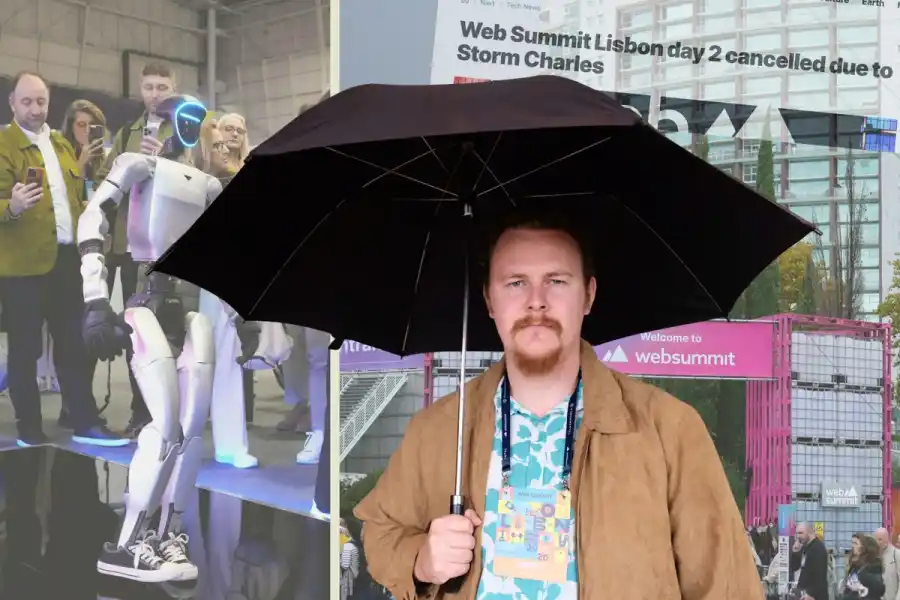
“They’ll all end up in landfill anyway,” says a young volunteer, pointing to a pile of confiscated umbrellas littering the black-and-white mosaic pavement outside the entrance to Web Summit in Lisbon, Portugal.
Hours earlier, security guards stopped me at the door and took my umbrella, as they did for thousands of other attendees, in the middle of one of the worst storms of the year.
I’ve come back to collect it, but the volunteer assures me there is no chance of finding it in the chaos. “Just pick one and take it home,” he says, shrugging with the air of someone just following orders.
My umbrella is a small loss. But it feels like a fitting symbol of an event, and a wider industry, that has largely sidelined sustainability issues – and grown tone deaf to the deep social troubles of our time.
Outside, Lisbon is being battered by a storm. Beyond it, a bigger one is raging in our societies – from a warming climate and a housing crisis to a soaring cost of living and political unrest.
Yet, inside the pavilions and arenas, Web Summit carries on as if the industry’s raison d'être is to keep peddling tech that no one needs.
Tech bros and gadget evangelists take to the stage preaching the future of AI-powered agents and machines, all promising to make our previously awful lives so much better.
Robots from Chinese firms AgiBot and Galbot were even listed as official speakers, a first in the event’s history. Galbot’s wheeled, two-armed machine can work real shifts in shops, pharmacies, and factories, according to its makers.
Meanwhile, sustainability has been pushed even further to the margins than in previous editions. The conference’s Planet:Tech sustainability track has been dropped this year, replaced by an Energy Summit largely about how to power AI.
Startups, many of which are building impactful solutions – from 3D scans that find cancerous tumours to cameras that predict and warn of incoming landslides – are confined to corners of the tented pavilions, with many desks and stands located near the toilets.
'Sustainability has been pushed even further to the margins'
Between each pavilion stand rows of food trucks serving burgers, hot dogs, and pizzas. Web Summit says it strives to be a zero-waste event, with recycling stations to sort the rubbish, but I couldn’t find any. (There were certianly none for the umbrellas!).
Outside, though, the world’s problems pile up on a meta scale.
Lisbon itself is in the grip of an acute housing crisis. Just a few kilometres from Web Summit, a group of housing campaigners spent weeks camped out in the city’s Rossio square, demanding affordable homes in a city where prices have skyrocketed in recent years.
The protestors planned to march on Web Summit on Wednesday. But, perhaps ironically, the storm got there first: day two of the event was cancelled on the government’s advice, as Storm Charles brought the threat of tidal flooding and high winds and Portugal shut schools and non-essential public services.
Web Summit says it is “where the future goes to be born”. But what future are they talking about? And for whom?
There are countless entrepreneurs and investors trying to solve some of the world’s biggest problems. Web Summit had the chance to put the best of tech on display and to lead from the front on sustainability.
Instead, it chose to be a platform for the shallow, even dystopian, side of tech, excluding many of the voices that would make this industry so much better.
P.S my umbrella was blue, with a wooden handle, and marked with the text "Göteborg" – if you have it, please let me know.