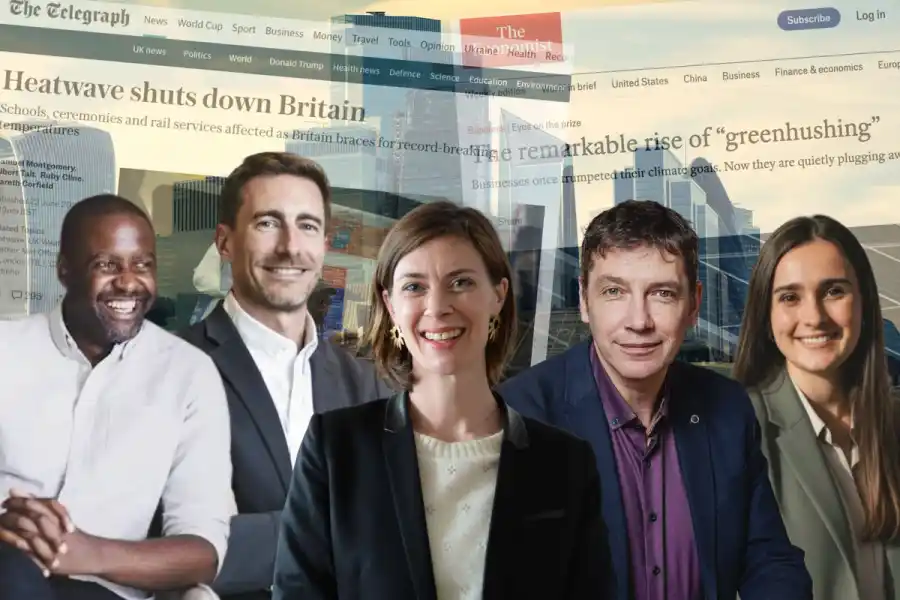
London Climate Action Week (LCAW) opened this week as one of Europe's most severe heatwaves in years swept across the continent – arriving, with some irony, just as green financiers are reconsidering how much they should use the word "climate."
Red heat alerts were issued across France, Spain, and several other nations. In France, Tuesday was the hottest day ever recorded.
Christophe Defert, a partner at Bridges Fund Management, a British impact investment firm, was on a train into central London when Impact Loop reached him.
Defert is speaking on panels throughout the event, which runs from 20-28 June, and says the heatwave has already become a central topic at Europe's largest climate gathering.
"It's probably both a positive and negative that the heatwave is happening now during LCAW," says Defert. "No doubt it accelerates the conversation, but at the same time it makes travelling to and experiencing the event much more difficult."
Andrew Wordsworth, managing partner at Sustainable Ventures, a London-based climate tech investor, spoke to Impact Loop from the firm's co-working space in County Hall – which, he noted, had the advantage of air conditioning at full capacity.
He has worked in the sector for nearly 25 years and thinks this heatwave may leave a more lasting impact than previous extreme weather events.
"It's always been about mitigation – you're just watching the graph [of atmospheric carbon emissions] go up," he told Impact Loop. "But gradually people are understanding that this is permanent. The world is not going to get colder. I think it’s a wake-up call."
A woman sunbathes in London as a heatwave bares down on the capital on Tuesday, June 23. Image courtesy: Kirsty Wigglesworth /AP via TT
Gosbert Chagula, a general partner at Future Impact Ventures, an early-stage climate tech VC firm raising its first £20m fund, has attended London Climate Action Week four times. He says the timing this year is a useful reminder of what the event is actually for.
"This heat has huge implications," Chagula tells Impact Loop. "The most vulnerable feel the impact the most. It's a reminder that we need to keep cutting emissions, but also work on adaptation and resilience too."
A sector in transition
The heatwave, and London climate week itself, lands at a turbulent moment for the climate investment community.
Many corporations and governments have slowed or watered down their climate commitments over the last year or so, while others have continued pursuing them without the fanfare – a pattern widely known as greenhushing.
Chagula says commitments have visibly weakened in some corners of the market, but the more significant change is in how the conversation itself has moved on.
"I think we've seen a withdrawal – a cooling period," he says. "But it's deeper than that. There's been an acknowledgement that the conversation needs to change. The climate conversation needs to intersect with quality jobs, quality work, better livelihoods. It's no longer just about carbon emissions."
Gosbert Chagula, general partner at Future Impact Ventures, is one of many climate investors that have begun reframing how they talk about sustainable investing.
Chagula has been to climate events across New York and London and says the shift is visible across all of them. “People are thinking more about building a better society overall," he says.
Wordsworth makes the same point from the perspective of his portfolio of climate tech startups.
He describes advising one portfolio company, a denim remanufacturing startup called Laundry, to strip all sustainability language from its investor pitch and sell itself purely on margins and efficiency. It is a version of greenhushing, applied not at a corporate level but at the level of a startup's fundraising pitch.
"Don't mention circular economy, don't mention climate," he describes telling the founder. "Just keep quiet and go back out to the market."
Wordsworth says the approach has worked and he now gives similar advice across the portfolio.
"You have to talk much more about the benefits of climate tech – we're creating high-productivity jobs, we're lowering costs," he says. "And then you go, oh, by the way, it also saves carbon."
As extreme weather events worsen, and sentiment cools of carbon mitigation, Wordsworth says water and nature are other areas where he thinks entrepreneurs can gain ground.
"Water could be the biggest crisis, sooner or later," he says. "And nature actually seems an easier sell – people can relate to it. If you don't do this, there'll be no more bats or birds left. That kind of stuff starts resonating."
That reflects a broader shift in how investors and founders approach green business – to focus less only on emissions and more on adaptation and resiliency.
Julia Reinaud, senior director at Breakthrough Energy – the clean energy investment firm founded by Bill Gates – travelled to London by train from Paris, where temperatures had already broken records. Writing on LinkedIn, she said the heatwave makes the stakes feel immediate in a way that long-range forecasts rarely do.
"There's something clarifying about discussing climate during one," she wrote. "This isn't a future challenge. It's already shaping how we live, work, and power our societies."
Reinaud called for greater focus on adaptation alongside decarbonisation, pointing to rising cooling demand, grid pressure, and the economic cost of extreme heat.
"When schools close and it's unsafe to work outdoors, economic resilience takes a hit," she wrote.
‘The pace is not enough’
While the heatwave bares down on Europe, and the sustainable investors grapple with a new political and economic reality, many watch, frustrated by the apparent slow pace of change.
Constance Perez, an investor at Climate Founders and founder of Munich Climate Week, wrote on LinkedIn that the gap between ambition and action remains wide.
"There is so much to be hopeful about," she wrote. "The innovation is real. The entrepreneurs are extraordinary. But the pace is not enough. The capital is not enough. And the public conversation is still mostly about who has a fan and who doesn't."
António Guterres, Secretary-General of the United Nations, addresses delegates at London Climate Action Week in June 2026. Image courtesy: X/Sadiq Khan
Meanwhile, others call out continued support for the fossil fuel industry as a glaring blindspot.
Sasja Beslik, chief investment strategy officer at SDG Impact Japan and a well-known figure in sustainable finance circles, pointed to the numbers behind that gap. In a LinkedIn post, he noted that the world's largest banks have channelled more than $7 trillion into fossil fuels since the Paris Agreement was signed.
"Europe is cooking," he wrote. "And yet, in one of history's most extraordinary acts of collective denial, we continue feeding the beast with oil and gas."
UN Secretary General António Guterres, addressing delegates at London climate week on Tuesday, drew the same line between cause and consequence.
"A climate crisis is pushing us deeper towards higher temperatures and closer to catastrophic tipping points," he said. "On the surface, these crises may seem separate, but they share the same destructive origin: fossil fuels."