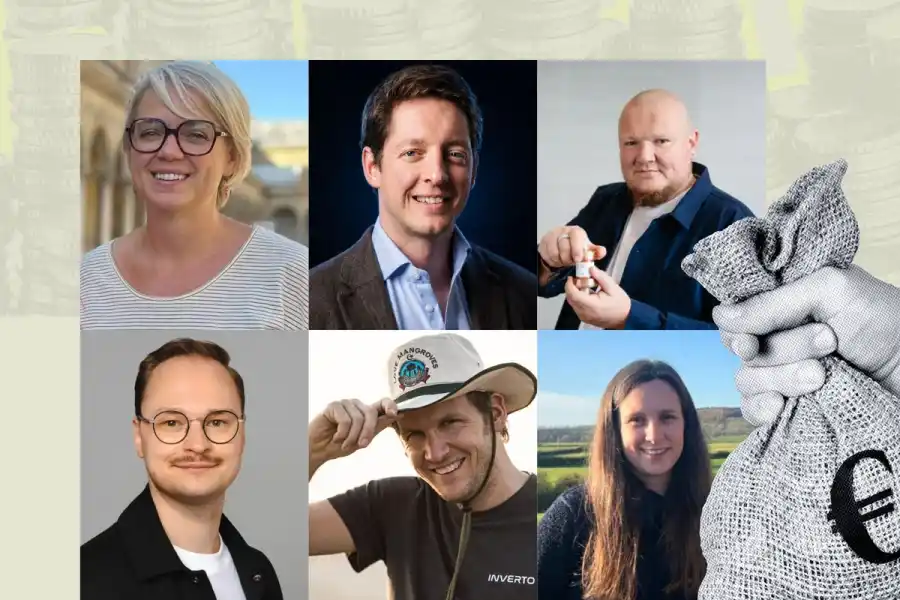
Another week, another cohort of founders raising capital across European impact. Impact Loop has picked out the deals that caught our eye, together with their backers.
Health and biotech make up four of this week’s picks, from Orakl Oncology’s cancer drug predictions to Efferon’s blood-filtering sepsis devices.
The largest figure belongs to sennder, although most of its €228m is credit lines rather than new equity.
sennder – €228m in debt and equity
About: Berlin-based sennder, founded in 2015, runs a digital road freight platform that matches shippers with independent truck carriers across Europe. The company says it reached positive EBITDA on a monthly basis in October and expects around €1bn in revenue this year.
Investors: Coface, the European Investment Bank, cflox and Deutsche Bank provided €155m in working-capital facilities. The remaining €73m is equity from existing shareholders led by Scania and Poste Italiane, which the company says it raised over the past three years.
What the money is for: The equity helped fund sennder’s takeover of C.H. Robinson’s European road freight business. The credit lines cover the gap between paying carriers and being paid by customers.
SRTD Biotech – €31.5m seed
About: SRTD Biotech spun out of the Forschungszentrum Jülich research centre in Germany in 2019 to develop mRNA medicines. According to the company, its drugs carry a molecular switch that turns them on only in cells showing specific disease markers, which leaves healthy cells alone.
Investors: Mérieux Equity Partners led the oversubscribed round, with NRW.BANK and Boehringer Ingelheim Venture Fund as co-leads. Lilly Ventures, High-Tech Gründerfonds and Anobis Asset also took part.
What the money is for: Preclinical work on programmes in cancer, autoimmune disease and fibrosis. None of its therapies has been tested in patients yet.
Orakl Oncology – €30.6m Series A
About: Paris-based Orakl Oncology spun out of cancer centre Gustave Roussy in 2023 and is led by co-founder and chief executive Fanny Jaulin. It grows patients’ tumours in the lab and tests drugs on them alongside medical data. The company says 18 of the world’s 20 largest drugmakers are in its sales pipeline.
Investors: Norrsken VC and Singular co-led the round. They were joined by InfraVia, Serena, Bpifrance’s Patient Autonome Fund, teampact.ventures and Plug and Play. Existing backers Verve Ventures, Speedinvest and HCVC returned, taking total funding to about €45m.
What the money is for: Orakl plans to generate five times more data and to expand from colorectal and pancreatic cancer into lung and gastric cancer. It is also opening teams in the US and UK.
Biomatter – €16.2m Series A
About: Vilnius-based Biomatter, founded in 2018 and led by co-founder and chief executive Laurynas Karpus, uses AI to design enzymes. It starts from the chemical reaction a customer needs rather than adapting enzymes found in nature. The company says it has delivered more than 50 custom enzymes to over 25 corporate customers, including AstraZeneca, BASF and Sanofi.
Investors: Astanor led the oversubscribed round. Existing investors UVC Partners, Inventure and Metaplanet also took part.
What the money is for: A 2,000 m² design and testing lab in Vilnius, due to open in 2027, which the company says should cut design cycles from weeks to days. Biomatter will also expand in the US, where about half its customers are based.
Gama – €15m seed
About: Gama, co-founded by chief executive Andrew Nutter and CTO Daniel Chapman, builds Wing, a fold-out solar array that powers satellites, at its site in Ivry-sur-Seine near Paris. It adapts the cheap silicon cells used on rooftops for use in space. Most satellite makers instead buy specialist cells, which can take a year or more to arrive.
Investors: Transition, Planet A, Draper Associates and Manta Ray backed the round.
What the money is for: Gama will build its first production line and hire around 60 engineers, tripling its team. Its first demonstration unit is due in summer 2027 through a partnership with satellite platform maker Eclipse Space.
PORT – €14.5m
About: London-based PORT, founded in 2020, turns underground car parks, warehouses and railway arches into hubs for electric delivery vehicles. It runs 24 hubs across London, Manchester and Birmingham and a fleet of 3,500 e-bikes.
Investors: The EBRD and Balnord led the round, joined by existing and new investors. PORT has now raised €29m in total.
What the money is for: PORT is fitting some of its e-bikes with cameras and lidar to train its own AI driving software. The data will feed autonomous delivery robots that it plans to add to its network.
triPica – €12.4m
About: Paris-based triPica was founded in 2016 by Mathieu Horn, Walid Bounar and Christophe Ruzé. It sells cloud billing and customer software to energy suppliers and telecom operators. The company says its software lets suppliers launch dynamic tariffs, solar self-consumption deals and EV charging plans in weeks, and German utility Enercity is a customer.
Investors: TiLT Capital Partners, the energy transition arm of French private equity group Siparex, provided the full amount.
What the money is for: Expansion in Germany and Italy, new hires and AI features for billing and customer support.
Efferon – €4.3m
About: Villach-based Efferon makes blood-filtering cartridges that remove bacterial toxins and inflammatory molecules from patients with sepsis, including a version for children. The company says its devices have been used in more than 25,000 treatments in over 40 countries.
Investors: Existing private investors from Germany, Austria and Switzerland funded the round.
What the money is for: Taking its devices into new markets.
Inverto Earth – €2.2m
About: Bern-based Inverto Earth was founded in 2022 by chief executive Jürg Germann and CTO Cameron Dowd. It builds drones that drop mangrove seeds, along with tools that track how restored coastlines recover. It works on projects in Senegal, Pakistan, Saudi Arabia and Indonesia.
Investors: Bloom Foundation led the round, joined by Zürcher Kantonalbank, Venture Kick, Kickfund, Techstars, Valery Foundation and SICTIC angels. Swiss innovation agency Innosuisse added public funding.
What the money is for: Combining its tools into one platform that guides restoration projects from choosing a site to monitoring results.
Rookwood Operations – €1.7m in equity and grant funding
About: Rookwood Operations, based in Wells, Somerset, and founded in 2022, removes phosphate pollution from rivers and lakes and returns it to farmland as fertiliser. Its cartridges are packed with a sponge-like organic material that binds phosphate. The company has trialled them at Chew Valley Reservoir with Bristol Water.
Investors: The British Business Bank’s South West Investment Fund put in €630k of equity through The FSE Group, as part of a €920k round. Sustainable Ventures and private angels also invested, and Innovate UK added a €800k grant.
What the money is for: Taking the technology to market.
Pictured: Fanny Jaulin (Orakl Oncology), Jane Pearce (Rookwood Operations), Laurynas Karpus (Biomatter), Andrew Nutter (Gama), Dima Romashin (Efferon) and Jürg Germann (Inverto Earth).